
Vehicle Mounted X-Ray Baggage Scanner | Godrej Security Solutions

Introduction: Security That Goes Where It Is Needed
Security threats do not stay at fixed checkpoints. A political rally, a cricket match, a VIP visit, a temporary railway entry gate or a customs post at a busy port can each need full baggage screening for a few hours or a few days, and then nothing at all.
Installing a permanent X-ray scanner at every such location is expensive and impractical. Carrying a conventional scanner on a truck and setting it up on the ground takes time, needs power, and leaves the equipment exposed to dust, heat and rain.
Godrej solves this with a complete X-ray baggage screening station built into a vehicle. It arrives on site, the entry and exit tables fold out, and screening can begin quickly, with its own power backup, air conditioning, CCTV and intercom on board. In Godrej's own words, it delivers fast, easy and reliable screening on the move.
This guide walks through every feature and specification in the catalogue and explains what each one means in practice for security teams, procurement officers and facility managers.

What Is Godrej Vehicle Mounted X-Ray Baggage Scanner ?
Godrej's range of Vehicle Mounted X-Ray Baggage Scanners. Each unit is a full X-ray screening machine integrated into a vehicle, built for VIP security and temporary screening points.
The range comes in several tunnel sizes, from 600 × 400 mm for hand baggage up to 1000 × 1000 mm for large parcels and cargo. Dual-view imaging is offered alongside the standard view configuration. Dual view scans each bag from two angles at once, which makes hidden or overlapping objects far easier to spot, so buyers can match the system to the threat level and throughput they expect.
It is designed for quick, flexible set-up at security checkpoints to inspect baggage, luggage and parcels at:
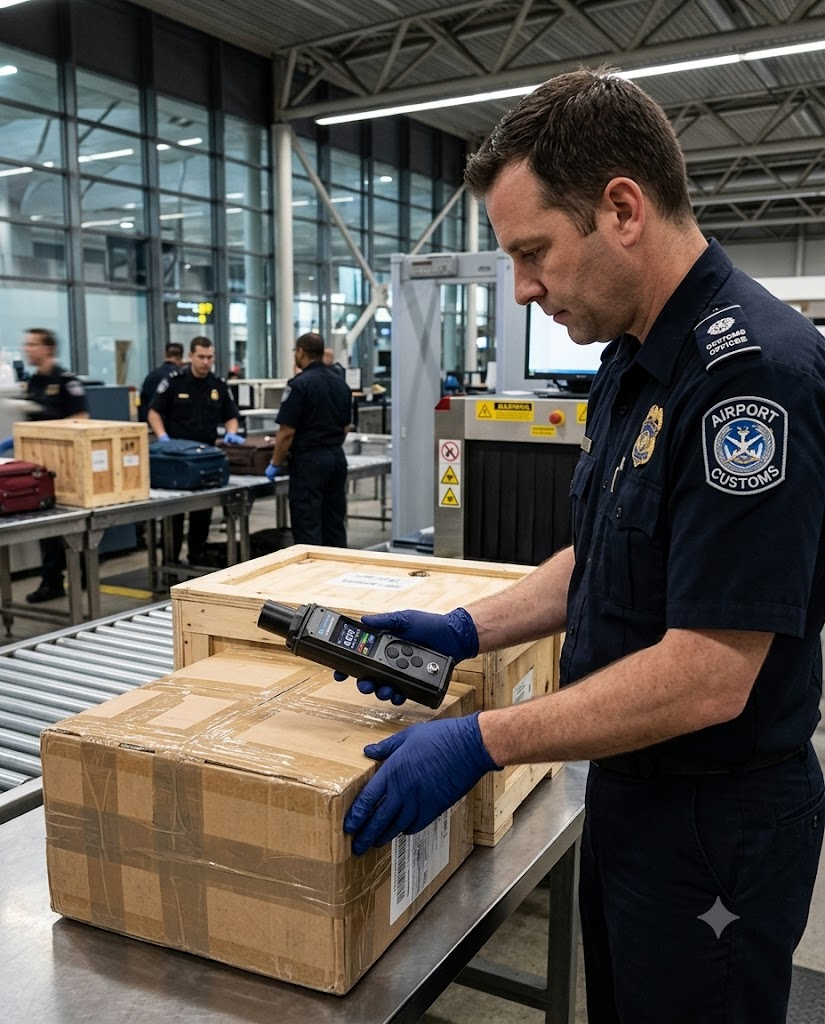
Airports and customs posts
Railway and metro stations
Political rallies and public events
Stadiums and other large venues
A self-contained screening station
What sets Godrej apart from a scanner simply loaded onto a truck is that the vehicle itself becomes the operating room. Every unit is equipped with:
CCTV system to record and monitor the entry and exit points
Intercom system so the operator inside can talk to staff at the loading and unloading points
Air conditioning to keep both the operator and the electronics at a safe working temperature
Power backup through a UPS or power generator
Flexible power switching between city mains supply and the onboard supply
This means the system can run at a site with no power connection at all, and switch to mains power where it is available to save fuel.
Key Features Explained
1. Superior and efficient detection capabilities
Godrej is built to find threats reliably without slowing the queue. It combines high steel penetration (37 mm standard, 39 mm typical), fine wire resolution and organic/inorganic material discrimination. Operators can spot weapons, dense objects and suspicious organic materials quickly, even at a busy checkpoint.
2. Integration on the Tata Winger Cargo
The scanner is integrated on the Tata Winger Cargo, an Indian-made vehicle (or equivalent SUV/MUV). Using a familiar domestic platform means spares and servicing are available across the country, drivers already know the vehicle, and running costs stay predictable.
3. Advanced X-ray photodiode array technology
The X-ray detector is an L-shaped photodiode array. The L shape lets the detector capture the full height and width of the tunnel, so no corner of a bag is missed. Photodiode arrays convert X-rays into a clear digital signal, giving sharp, low-noise images.
4. Motorised and foldable entry and exit tables
The entry and exit tables are motorised and fold away when the vehicle is moving. On site, they deploy to give a proper loading and unloading surface. Bags and parcels can be placed and collected easily, which speeds up handling and reduces strain on staff.
5. CCTV monitoring
CCTV cameras cover the entry and exit points. Supervisors get a recorded view of who placed each bag and who collected it, which helps with incident review and deters tampering.
6. Advanced self-diagnostic reporting
The system runs self-diagnostics at start-up and continuously during operation, and alerts the user to any fault. Problems are caught before they affect screening quality, and service engineers get a clear starting point.
7. Lower total cost of ownership
One vehicle can serve many locations instead of buying a fixed scanner for each. Add the 100% duty cycle, sealed oil-bath cooling and rodent protection, and the result is lower lifetime cost per checkpoint.
The Model Line-up
Four models cover everything from hand baggage to large parcels. All share the same conveyor height and speed; they differ in tunnel size, load capacity, weight and power draw.
Specification | KV604CVS | KVG550VS | KV7560VS | KV100100VS |
Tunnel opening (W × H) | 600 × 400 mm | 650 × 500 mm | 750 × 600 mm | 1000 × 1000 mm |
Overall dimensions (L × W × H) | 2020 × 900 × 1330 mm | 2020 × 950 × 1360 mm | 2020 × 950 × 1330 mm | 2020 × 950 × 1330 mm |
Conveyor load capacity (evenly distributed) | 160 kg | 175 kg | 190 kg | 200 kg |
Conveyor / belt speed | 0.18–0.3 m/s, bidirectional | 0.18–0.3 m/s, bidirectional | 0.18–0.3 m/s, bidirectional | 0.18–0.3 m/s, bidirectional |
Conveyor height | 450 mm | 450 mm | 450 mm | 450 mm |
Scanner weight | 380 kg | 450 kg | 550 kg | 900 kg |
Power consumption (full load) | 0.5 kVA | 0.6 kVA | 0.8 kVA | 1 kVA |
All dimensions and weights are approximate, as stated in the catalogue.
What these specifications mean
Tunnel opening is the largest item the scanner can accept. The 600 × 400 mm KV604CVS suits handbags, backpacks and cabin luggage. The 650 × 500 mm and 750 × 600 mm models take check-in suitcases. The 1000 × 1000 mm KV100100VS handles large cartons, parcels and cargo.
Overall dimensions describe the scanner unit inside the vehicle. All models share a 2020 mm length, so they fit the same vehicle platform.
Conveyor load capacity is the maximum weight on the belt when spread evenly, from 160 kg up to 200 kg.
Bidirectional belt speed of 0.18–0.3 m/s lets the operator reverse a bag back into the tunnel for a second look without unloading it.
450 mm conveyor height is a comfortable working level for loading bags from the fold-out tables.
Weight matters for vehicle payload. The scanner ranges from 380 kg to 900 kg.
Power consumption of 0.5–1 kVA is modest enough to run for long periods on the onboard UPS or generator.
Vehicle Chassis Specifications
The vehicle is not just transport; it is the scanner's housing, power plant and control room.
Parameter | Specification | What it means for you |
Vehicle type | Indian-make Tata Winger or equivalent SUV/MUV | Proven domestic platform with nationwide service support |
Engine type | Diesel / CNG | Choose the fuel that suits your fleet and local emission rules |
Engine capacity | 1900–2200 cc | Enough power to carry the scanner and onboard systems comfortably |
Ground clearance | 160–200 mm (laden) | Handles Indian roads, speed breakers and unpaved event grounds |
Air conditioning | Dual driven AC | Cools both cabin and scanner area, protecting operators and electronics |
Floor type | Anti-slip / synthetic floor | Safe footing for staff working inside the vehicle |
CCTV | Surveillance of entry and exit points | Recorded evidence of every bag in and out |
External supply | Easy switch from internal backup to mains | Use city power when available, onboard power when not |
Power backup | UPS or generator | Uninterrupted screening even during outages |
Dimensions | 4920 × 1905 × 2445 mm (L × W × H) | Compact enough for city streets and standard parking bays |
Gross weight | 2850 kg | Full operating weight of the vehicle with scanner |
General X-Ray Specifications Explained
These figures define how well the scanner sees inside a bag and how reliably it runs.
Parameter | Specification |
Steel penetration | 37 mm standard, 39 mm typical |
Wire resolution | 40 AWG typical, 38 AWG guaranteed |
Power requirements | 230 VAC (160–280 VAC), 50 Hz, 6 A |
Video display | 22-inch high-resolution LED colour monitor |
X-ray tube voltage | 160–180 kV |
Tube current | 0.7–1.2 mA |
Cooling | Sealed oil bath with forced air |
Duty cycle | 100% |
X-ray detector | L-shaped photodiode array |
Storage / operating temperature | −20 °C to 70 °C / 0 °C to 50 °C |
Humidity | Up to 95%, non-condensing |
Contrast sensitivity | 24 visible levels, 4096 grey levels |
Beam divergence | Downward |
Display resolution | 1920 × 1280, 24-bit colour per pixel |
Steel penetration (37–39 mm) is how thick a steel plate the X-rays can pass through and still show what is behind it. Higher penetration means a weapon cannot easily be hidden behind dense metal objects.
Wire resolution (38–40 AWG) is the thinnest wire the system can display. 40 AWG wire is about 0.08 mm thick, so detonator wires and circuit traces in improvised devices stand out clearly.
Wide input voltage (160–280 VAC) keeps the scanner working through the voltage swings common on Indian mains and generator supplies.
Tube voltage of 160–180 kV and current of 0.7–1.2 mA set the X-ray energy and intensity. Higher voltage gives deeper penetration through dense luggage.
Sealed oil-bath cooling with forced air keeps the X-ray generator cool in hot climates and protects it from dust, a key advantage for outdoor use.
100% duty cycle means the scanner can run continuously all day without rest periods.
Operating range of 0–50 °C and humidity up to 95% suits Indian summers and monsoon conditions.
4096 grey levels and 24 visible levels let operators separate subtle differences in density, such as powders inside a container.
Downward beam divergence projects X-rays from above, with the detector wrapped around the tunnel, for consistent imaging across the conveyor.
Image Specifications and Processing
A scanner is only as good as the image the operator sees. The software gives operators the tools to examine every bag in detail.
Display type
Six-colour imaging software with a 1280 × 1024 image size and 4096 grey-scale levels. Different materials appear in different colours, so the operator can read a bag's contents at a glance.
Image processing tools
Black & white for a classic density view
Pseudo colour to highlight subtle density differences
Negative / inverse to reveal objects hidden in dark, dense areas
Variable edge enhancement to sharpen outlines of wires, blades and components
Continuous contrast and brightness adjustment to fine-tune any part of the image
Material discrimination
Organic and inorganic energy-stripping material discrimination separates materials by their atomic make-up. Organic materials such as explosives, narcotics and food show in one colour; metals and inorganic materials show in another. This is central to spotting explosives and drugs.
Zoom
Variable zoom up to 64×, with a pan option and 9-zone zoom. Operators can enlarge any part of a bag, move around the image, and jump straight to one of nine zones.
Image storage and recall
Real-time storage of 200,000 images, with storage on a network or removable hard disk also possible
Image recall: all stored images can be retrieved manually using multiple search parameters
Stored images support investigations, audits, training and evidence if an incident occurs.
Safety and Certifications
It is built to be safe for operators, the public and the items being screened.
Certifications
AERB certified (Atomic Energy Regulatory Board), India's regulator for radiation-emitting equipment. AERB type approval is required to operate X-ray baggage scanners legally in India.
ISO 9001:2008 quality management
ISO 14001 environmental management
CE certified, meeting European safety, health and environmental standards
Food safety certified, so food items pass through without harm
Radiation safety
Parameter | Specification | What it means |
Dose per scan | Less than 0.1 mR | A tiny exposure to the bag; harmless to food, medicines and electronics |
Radiation leakage | Less than 0.1 mR/hr | Very low leakage outside the tunnel, keeping operators and the public safe |
Film safety | Safe for 10 passes of 1600/33 DIN photo film | Even very sensitive camera film can be scanned repeatedly without damage |
Other safety features
Electrical safety protection
Emergency stop button
X-ray ON indicator lamps, so everyone knows when X-rays are being generated
Audio and visual alarms
Lead safety screens (curtains) at the tunnel openings
Machine hardening: rodent protection is available, important for vehicles parked outdoors for long periods
Hardware and Software Specifications
The operator console combines a modern computer with screening software built for security work.
Feature | Specification | Benefit |
System access | 4 secure levels of access | Operators, supervisors, administrators and service staff each see only what they need |
High density alert | Alarm when a configurable high-density threshold is met (in base price) | Flags objects too dense to penetrate, where a threat could be hidden |
Threat Image Projection (TIP) | Included in base price | Inserts virtual threat images into real scans to train and test operator alertness |
Machine diagnostics | Start-up and continuous self-diagnostics with fault alerts | Faults are caught early, keeping screening reliable |
Tagging | Automatically tracks baggage count, date and time | Built-in throughput records and audit trail |
Hardware | Intel i5 or higher, 22-inch monitor, 8 GB RAM, 1 TB HDD/SSD | Fast image processing and plenty of storage |
Print on demand (printer not provided) | Hard copies of images for reports or evidence | |
Tables | Incoming and outgoing modular roller tables | Smooth loading and collection of bags |
Why TIP and high-density alerts matter
On a long shift, operator attention naturally drops. Threat Image Projection keeps operators alert by occasionally showing a simulated threat and recording whether it was spotted. Supervisors get objective performance data for training.
The high-density alert covers a different risk: a bag deliberately packed with dense material to block X-rays. Instead of relying on the operator to notice, the system raises an alarm automatically. Both features come in the base price.
Options and Accessories
It can be extended to match each deployment.
Network integration: connect seamlessly to a security network for central monitoring and remote image review.
Explosives and narcotics detection assistance: software support that helps operators identify likely explosives and drugs.
Monitors: a 22-inch monitor as standard, with a dual-monitor set-up available for a wider view and faster analysis.
Accessories:
Combined test piece, to verify image quality and performance regularly
In and out cameras, to record bags entering and leaving the tunnel
Foot mat
Mobile casters
Operator's console cabinet
Dust-proof cover, to protect the system when not in use
Applications
It fits any organisation that needs screening at changing or temporary locations.
Sector | Typical use |
Police and paramilitary | VIP movements, election duty, rallies, checkpoints and emergency deployments |
Government offices | Temporary screening during events, visits or heightened alerts |
Defence establishments | Gate screening, field deployments and visitor checks |
Airports and seaports | Extra screening capacity at peak times, cargo areas and customs checks |
Hotels and corporate offices | Conferences, summits and high-profile guest visits |
Metro and railway stations | Festival crowds, new station openings and alert periods |
It also suits stadiums, concerts, exhibitions and political rallies, anywhere a crowd gathers for a limited time.
How to Choose the Right Model
If you mainly screen… | Consider | Why |
Handbags, backpacks, cabin bags at events and offices | KV604CVS | Smallest, lightest (380 kg) and lowest power draw (0.5 kVA) |
Mixed hand and medium luggage | KVG550VS | 650 × 500 mm tunnel with 175 kg belt capacity |
Check-in suitcases at railway stations and airports | KV7560VS | 750 × 600 mm tunnel takes most large suitcases |
Large parcels, cartons and cargo at ports and customs | KV100100VS | 1000 × 1000 mm tunnel and 200 kg belt capacity |
Frequently Asked Questions
Can it work where there is no electricity? Yes. It has onboard power backup through a UPS or generator, and can switch to city mains when available.
Is it safe for the public and for food or electronics? The dose per scan is under 0.1 mR and leakage under 0.1 mR/hr. It is food-safety certified and film safe up to 1600 ISO (33 DIN) for 10 passes.
Is it approved for use in India? The system is AERB certified, as required for X-ray baggage scanners in India, and also carries CE, ISO 9001:2008 and ISO 14001 certification.
Can it run all day? Yes. It has a 100% duty cycle and a sealed oil-bath cooled X-ray generator built for continuous operation.
How are operators trained and monitored? Threat Image Projection (TIP) is included in the base price, along with four levels of secure access and automatic baggage counting.
How many images can it store? Up to 200,000 images in real time, with network or removable hard-disk storage also possible.
Godrej brings airport-grade X-ray screening to any location, on wheels. It pairs strong detection (39 mm steel penetration, 40 AWG wire resolution, material discrimination and 64× zoom) with a self-contained vehicle that carries its own power, cooling, CCTV and intercom.
For police, defence, transport hubs, event organisers and corporates, it means one investment can secure many sites, with fast set-up, reliable all-day operation and full regulatory compliance.
Looking to deploy mobile baggage screening? Contact us to discuss which model fits your requirements, request a demonstration, or get a quotation.





Comments