
Crash Rated Movable Vehicular Barrier | Godrej Security Solutions

Crash Rated Movable Vehicular Barrier: India's First Foundation-Free Perimeter Protection
Discover Godrej's Crash Rated Movable Vehicular Barrier, India's first movable barrier certified to PAS 68, tested to stop a 7,500 kg truck at 48 km/h. Modular, quick to deploy, and built from high-grade carbon steel.
Introduction: Why Vehicle Threats Demand a Different Kind of Barrier
Most organisations think of perimeter security in terms of walls, gates, guard booths and CCTV. These work well against people on foot. They do very little against a vehicle.
A heavy vehicle driven at speed can breach an ordinary gate or boundary wall. Whether the cause is a deliberate attack or a loss of control, the damage can be severe. This is why high-risk sites such as government buildings, airports, data centres, energy facilities, embassies, event venues and corporate campuses use crash rated vehicle barriers as a dedicated layer of protection.
Traditional crash rated installations have a big drawback. They usually need excavation, deep foundations and civil works. That means time, cost, disruption and permanent changes to the site.
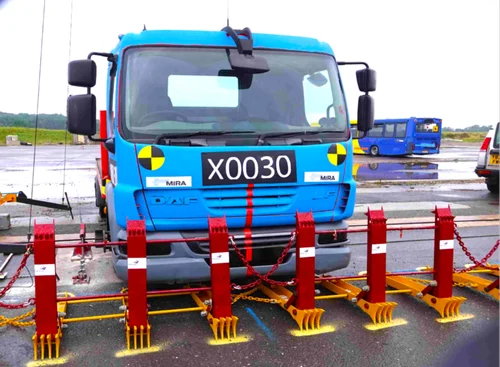
The Crash Rated Movable Vehicular Barrier was designed to remove that trade-off. It is India's first movable vehicular barrier, built for quick deployment without a foundation. This post covers each feature of the product and what it means for your site.
Product at a Glance
Feature | Details |
Product type | Crash rated movable vehicular barrier |
Installation | No foundation required; modular; installed within minutes |
Crash rating | PAS 68 certified |
Test conditions | 7,500 kg truck at 48 km/h |
Test facility | Horiba MIRA, UK |
Flexibility | Individual units fit together to suit different entrance widths |
Material | High-grade carbon steel |
Dimensions (block of three units) | Height 700 mm, length 1,000 mm, width 1,200 mm |
Feature 1: India's First Movable Vehicular Barrier
The most distinctive thing about this product is that it is movable. Conventional crash rated bollards and barriers are fixed assets. Once installed, they stay where they are, and relocating them means demolition and rebuilding.
A movable barrier changes this in practical ways:
Security can follow your needs. If your risk profile changes, the barrier can be redeployed.
Temporary events become easier to secure. Exhibitions, public gatherings, VIP visits and construction phases all create short-term vehicle risks. A movable barrier lets you protect these without permanent works.
Leased and temporary premises are covered. If you cannot make permanent alterations to a building or site, a foundation-free solution lets you add protection anyway.
Rapid response is possible. When a threat level rises, a barrier that deploys in minutes lets you strengthen the perimeter quickly.
Being the first of its kind in India also means a solution designed for Indian security needs is now available, in a category that previously relied heavily on fixed installations.
Feature 2: Quick Deployment Without a Foundation
The catalogue describes the product as designed for quick deployment without the need for a foundation, and says it is modular and can be installed within minutes.
Why foundations matter
Fixed crash rated barriers work by anchoring into the ground. Deep foundations transfer the force of an impact into the earth. Building them involves digging, pouring concrete, curing time and often work around underground utilities. The process can take days or weeks and disturbs the site.
What "no foundation" means for you
No excavation or civil works, so no digging up driveways, entrances or paved areas.
Less disruption. Operations at your facility can continue while the barrier is set up.
Faster time to protection. Installation takes minutes rather than the days or weeks fixed installations can need.
Lower dependence on site conditions. You do not have to worry as much about what lies beneath the surface.
For security managers under time pressure, whether from a new threat assessment, an upcoming event or a compliance requirement, this speed is a major advantage.
Feature 3: Certified to the PAS 68 Standard
A barrier that looks strong is not the same as a barrier proven to be strong. That is why certification matters.
What is PAS 68?
PAS 68 is a recognised standard for vehicle security barriers. It sets out how barriers are tested against a moving vehicle in a controlled, repeatable impact test. A barrier that is certified to PAS 68 has had its performance independently demonstrated rather than simply claimed.
Why it matters to buyers
Verified performance. Your security investment rests on a test result, not a manufacturer's assurance.
Easier procurement and approvals. Security consultants, regulators and risk assessors often ask for crash rated certification.
Confidence for stakeholders. Management, insurers and occupants can rely on a proven standard.
Feature 4: Tested to Stop a 7,500 kg Truck at 48 km/h
The catalogue states that the barrier was tested to stop a 7,500 kg truck at 48 km/h at Horiba MIRA, UK. This is the most important performance figure for the product.
Putting the numbers in perspective
A 7,500 kg vehicle is a heavy truck. It is far heavier than a car or SUV and carries a great deal of momentum. At 48 km/h (about 13.3 metres per second), the kinetic energy involved is roughly 667 kilojoules. This is a rough illustrative calculation from the stated mass and speed, not a figure from the catalogue.
Stopping that much energy with a barrier that has no foundation is a considerable engineering achievement. It shows that the barrier's design, its modular units and its high-grade steel construction work together to absorb and resist the impact.
Why the test location matters
Horiba MIRA is an established vehicle testing facility in the United Kingdom. Testing at a recognised, specialised facility adds credibility. The result comes from a proper test environment rather than informal trials.
Where this level of protection is relevant
A 7,500 kg truck at 48 km/h represents a realistic threat in many urban and commercial settings. Typical sites that benefit from this level of protection include:
Government and administrative buildings
Airports and transport hubs
Corporate campuses and IT parks
Data centres and critical infrastructure
Stadiums, exhibition grounds and event venues
Hotels, malls and other high-footfall locations
Embassies and diplomatic premises
(Always have a qualified security consultant assess your site's specific threat level and required rating.)
Feature 5: Modular and Flexible for Any Entrance Width
No two sites are the same. Entrances differ in width, and a one-size-fits-all barrier either leaves gaps or has to be custom-made at greater cost and lead time.
The catalogue notes that individual barrier units can be fitted together to protect varying entrance widths.
Benefits of the modular approach
Scalable protection. Protect a narrow service gate or a wide main entrance by joining the right number of units.
Adaptable over time. If your entrance layout changes, you can reconfigure the barrier instead of replacing it.
Efficient planning. You buy the number of units you need rather than a fixed-size installation.
Easier handling. Smaller units are generally more practical to move and position than a single large structure.
Modularity is also what makes the product's movability practical. The system can be assembled where it is needed and reconfigured when requirements change.
Feature 6: Built from High-Grade Carbon Steel
A barrier's ability to take an impact depends heavily on its materials. The Crash Rated Movable Vehicular Barrier is constructed from high-grade carbon steel.
Why carbon steel?
Carbon steel is widely used in structural and security applications because of its strength and toughness. In a crash barrier, the material has to resist deformation and absorb energy under a sudden, severe load. Using a high-grade steel supports the barrier's certified performance.
What this means in practice
Strength where it counts. The material is suited to the demands of stopping a heavy vehicle.
Durability. Steel construction suits a product intended for repeated deployment and outdoor use.
Robust build quality. The barrier is a serious security product, not a lightweight, deterrent-only measure.
Feature 7: Compact, Defined Dimensions
The catalogue specifies the dimensions of each block of three units:
Height: 700 mm
Length: 1,000 mm
Width: 1,200 mm
What these dimensions tell you
A low profile. At 700 mm tall, the barrier is relatively low. This can make it less visually intrusive than tall walls or large installations, though it is still a clear physical obstacle to vehicles.
A compact footprint. At 1,000 mm by 1,200 mm per block, the barrier is manageable to place at gates and entrances, where space is often limited.
Easy planning. Clear dimensions let you work out layout, spacing and the number of blocks needed for your entrance width ahead of time.
Who Should Consider a Crash Rated Movable Vehicular Barrier?
This product suits many types of organisation:
Facilities with changing security needs. If threat levels rise and fall, a movable barrier scales with them.
Event organisers and venue managers. It provides vehicle protection for temporary events without permanent works.
Sites where excavation is impractical. This includes heritage sites, leased buildings and areas with underground services.
Organisations needing fast deployment. When you need protection in minutes rather than weeks, this is the right fit.
Security consultants and integrators. A certified, modular, foundation-free option adds flexibility to your designs.
Key Benefits Summary
Proven protection: PAS 68 certified, tested to stop a 7,500 kg truck at 48 km/h
Speed: Modular, installed within minutes
No civil works: No foundation required
Flexibility: Units fit together for different entrance widths
Strength: Built from high-grade carbon steel
Mobility: India's first movable vehicular barrier, relocatable as your needs change
Clear specifications: Defined dimensions for easy planning
Frequently Asked Questions
Is this barrier really installed without a foundation?Yes. It is designed for quick deployment without the need for a foundation, and it is modular so it can be installed within minutes.
What standard is the barrier certified to?It is certified to the PAS 68 standard.
What was it tested against?It was tested to stop a 7,500 kg truck at 48 km/h at Horiba MIRA, UK.
Can it be used for wide entrances?Yes. Individual barrier units can be fitted together to protect varying entrance widths.
What is it made of?High-grade carbon steel.
What are the dimensions?Each block of three units is 700 mm high, 1,000 mm long and 1,200 mm wide.
Conclusion: Strong Protection Without the Construction
Protecting a perimeter against vehicle threats no longer has to mean long construction projects and permanent changes to your premises. The Crash Rated Movable Vehicular Barrier offers certified, tested protection that is modular, built from high-grade carbon steel and deployable in minutes without a foundation.
If you are reviewing your site's perimeter security, whether for a permanent entrance, a temporary event or a changing risk environment, this is a product worth evaluating.




Comments