
Rogue Drone and Pilot Detection by Radio-frequency Analysis - Hydra | Godrej Security Solutions

Securing Near Airspace: Unveiling HYDRA – The Ultimate Radio-Frequency Drone and Pilot Detection System
In an era where unmanned aerial vehicles (UAVs) or drones are becoming smaller, faster, cheaper, and increasingly autonomous, the threat to critical infrastructure, public events, VIPs, and sensitive facilities has evolved exponentially. Drones guarantee high levels of anonymity and impunity for malevolent actors, bypassing traditional physical security boundaries to execute contraband delivery, industrial espionage, operational disruption, or kinetic attacks.

To counter these asymmetrical aerial threats, HYDRA serves as a premier, high-performing first line of defense. Built on state-of-the-art Radio-Frequency (RF) Signal Intelligence (SIGINT) analysis, HYDRA provides real-time detection, identification, and directional tracking of both rogue drones and their remote pilots.
Why Detection Matters: The Case for Radio-Frequency Analysis
Rogue drones are becoming too discrete to detect with human senses. By the time a drone is visually spotted or heard, it is often too late to prevent an incident. Effective airspace protection requires early detection, positive identification, and precise localization—providing security teams with actionable lead time to neutralize the threat or initiate response protocols (e.g., VIP extraction, pilot interception, critical asset lockdown).
While several counter-UAV (C-UAS) technologies exist—including Radar, Acoustics, and Electro-Optical/Infrared (EO/IR) cameras—Radio-Frequency (RF) Analysis represents the most balanced, cost-effective, and reliable primary detection capability.

Advantages of RF-Based Detection with HYDRA
:
Zero Interference (Passive Sensing): Operates purely passively without emitting signals, ensuring zero disruption to existing communications, Wi-Fi networks, or civil aviation navigation.
Simultaneous Drone & Pilot Localization: Captures both the uplink (pilot controller to drone) and downlink (drone video/telemetry to pilot) signals to track both targets.
Low False Alarm Rate: Advanced signal intelligence algorithms distinguish genuine drone signatures from surrounding environmental RF noise.
Exceptional Range in Urban Environments: Works effectively in dense urban settings and complex radio frequency landscapes.
Cost Efficiency: Delivers superior coverage and capability at a fraction of the cost of heavy radar or complex EO/IR tracking systems.
Key Takeaways & Operational Highlights
Dual Target Tracking: Precise direction finding and bearing accuracy of +- 7 Degree for both the rogue drone and its pilot controller.
Long-Range Surveillance: Average detection range of 2 km (up to 5 km under optimal line-of-sight conditions).
Instant Classification: Rapidly identifies drone type, brand, and communication protocol.
Multi-Drone Capability: Detects and tracks multiple simultaneous drone threats operating across different frequency bands.
Rapid Deployment: Highly portable; setup takes just 20 minutes with 2 operators (2 PAX).
Rugged & All-Weather Ready: Ingress protection rating of IP67 and operational temperatures from -20°C to +55°C.
Seamless Scalability: Easily integrates with Command and Control (C2) hypervisors and additional physical effectors or neutralization systems.

Complete Hardware & Software Architecture
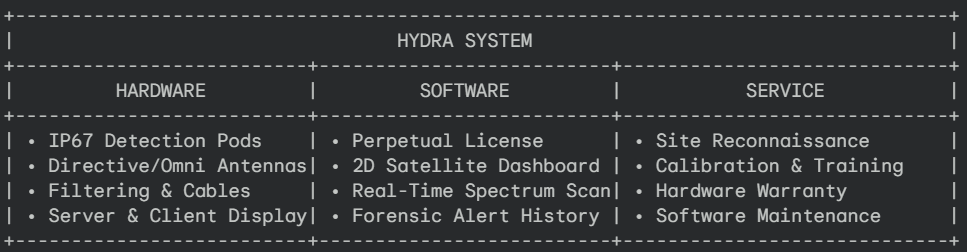
The HYDRA ecosystem is built on a modular architecture divided into hardware, perpetual software licenses, and comprehensive operational services.
1. Hardware Architecture
Each detection node consists of an outdoor-rated sensor masthead housing high-sensitivity detection pods, specialized filters, directional or omnidirectional antennas, and ruggedized power/data connectivity.
Connectivity: Standard Gigabit Ethernet (Ethernet 1000 Base T) for high-speed data streaming.
Power Supply: Power over Ethernet Plus (PoE+ 802.11at), requiring a maximum of only 30W per sensor, minimizing cabling complexity.
2. Software Functionalities
HYDRA operates on a perpetual software license designed for intuitive user experience during high-stress operational events:
2D Satellite View Dashboard: Displays real-time bearing lines, threat locations, and geo-referenced situational awareness map overlays.
Real-Time RF Spectrum Scanning: Provides signal analysts with real-time spectrum visualization to evaluate localized RF activity.
Forensic Alert History: Logs all historical detection data, threat signatures, timestamps, and bearing histories for post-incident investigation, evidence gathering, and judicial prosecution.
Effectors & Sensor Management: Centralized configuration panel to set alerts, sensitivity thresholds, and trigger automated countermeasures.
Product Configurations: HYDRA 100 vs. HYDRA 200
HYDRA is offered in two main baseline hardware configurations to cater to varying operational requirements and facility sizes:

Technical Feature | HYDRA 100 | HYDRA 200 |
Primary Focus | Cost-effective omnidirectional detection | High-precision directional tracking & direction finding |
Average Detection Range | 1 km | 2 km |
RF Spectrum Coverage | Standard: 2.4 GHz / 5.8 GHz | Standard: 2.4 GHz / 5.8 GHz |
(Optional: 433 / 860 / 915 MHz) | (Optional: 433 / 860 / 915 MHz) | |
Detection Accuracy | Omnidirectional 360 Degree across all spectrums | Bearing +- 7 Degree on 2.4/5.8 GHz (Omni on lower frequencies) |
Sensor Count (Per Node) | 1 sensor (2 with extended spectrum) | 4 sensors (5 with extended spectrum) |
Recommended Spacing | 2 km between nodes for maximum coverage | 4 km for maximum coverage / 1–2 km to cross bearings |
Max Operational Altitude | Up to 200 meters | Up to 1,000 meters (1 km) |
Masthead Dimensions | 48x48x160cm (210 cm with extended spectrum) | 48x48x78cm (240 cm with extended spectrum) |
Masthead Weight | 10Kg (17 kg with extended spectrum) | 25Kg (32 kg with extended spectrum) |
Weather Protection | IP67 rated | IP67 rated |
Operating Temperature | -20 to 55 Degree Celcius | -20 to 55 Degree Celcius |
Environmental Range Capabilities
Detection distances are influenced by local topographical features, surrounding concrete/steel structures, ambient RF background noise (RF pollution), and atmospheric conditions:
[HYDRA 100 Coverage]
  - Bad Conditions / Urban Noise : 1.0 km
  - Normal Operating Conditions : 1.5 km
  - Optimal / Clear Line-of-Sight : 2.5 km (Max Altitude: 200m)

[HYDRA 200 Coverage]
  - Bad Conditions / Urban Noise : 1.0 km
  - Normal Operating Conditions : 2.0 km
  - Optimal / Clear Line-of-Sight : 5.0 km (Max Altitude: 1,000m)
Modular Scalability & Advanced Customization
1. Cross-Bearing Triangulation
By deploying multiple HYDRA 200 nodes separated by 1-2Km, the system automatically crosses bearing lines from different sensors to calculate the exact coordinate location (grid position) of both the rogue drone and its pilot on the satellite map interface.
2. Multi-Tiered Sensor Networks
Combine HYDRA 100 and HYDRA 200 nodes across complex topographies, large perimeter borders, or multi-building corporate campuses. All nodes report back to a single unified Client-Server C2 system, providing centralized control from a single operator workstation.
3. Mobility & Tactical Deployment Kits
For temporary event protection (e.g., VIP speeches, stadium sports events, outdoor expos, tactical military stops), HYDRA can be equipped with a tactical Mobility Kit:
Ruggedized transport Pelican-style hard cases.
Semi-rugged field laptop for harsh operational conditions.
Quick-deploy telescopic mast and military-grade PoE network switch.

4. Spectrum Extension Module
Expand standard 2.4/5.8 GHz detection to lower frequency bands (433 MHz, 860 MHz, and 915 MHz). This ensures protection against custom-built, long-range, or non-standard commercial radio protocols used by advanced threats.
5. Multi-Layer C2 Integration
HYDRA’s software architecture supports integration with secondary detection layers (such as radar or optical PTZ cameras) and active soft-kill/hard-kill neutralization systems (RF jammers, cyber-takeover tools, net catchers) to build a multi-layered defense network.

Conclusion: Take Control of Your Near Airspace
Rogue drone incidents are no longer a theoretical risk—they are a daily reality for critical infrastructure, defense installations, public venues, and corporate facilities worldwide. HYDRA offers an uncompromised blend of long-range passive detection, high bearing accuracy, rapid portability, and low operational footprint.
Ready to secure your airspace against UAV threats? Contact our security defense specialists today to schedule an on-site reconnaissance survey, risk evaluation, or live system demonstration.





Comments