
Radiation Portal Monitors | Godrej Security Solutions

Radiation Portal Monitors: A Complete Guide to Detecting Radioactive and Nuclear Materials in Motion
Learn how Radiation Portal Monitors (RPMs) work, what they are made of, where they are used, and how the PM5000 series compares for vehicles, pedestrians and luggage.

Introduction

Radioactive and nuclear materials can move through the world unnoticed: in a truck at a border crossing, in a bag at an airport, in a consignment of scrap metal, or in a parcel at a post office. Radiation Portal Monitors (RPMs) are the first line of defence against this. They are fixed, always-on detection systems that scan people, vehicles and goods as they pass through a controlled area, without stopping the flow of movement.
This guide covers what an RPM is, how it works, what it is made of, where it is used, and how each model in the PM5000 range performs.
What Is a Radiation Portal Monitor?
An RPM is intended for detecting moving radioactive and nuclear materials through a controlled area or premises. Items do not need to be stopped, opened or inspected by hand. They simply pass through the monitored zone, and the system alerts operators if radiation above background levels is detected.
This makes RPMs well suited to places with high throughput, such as borders, airports, ports and industrial sites, where manual checks would be slow and disruptive.
How Do RPMs Work?
RPMs use gamma and gamma-neutron radiation detection to identify objects with different densities or elemental compositions, distinguishing them from surrounding materials.
In practice, every environment has a natural radiation background. The monitor continuously measures this background, and when an object passes through with a radiation signature that stands out from it, the system raises an alarm. Detecting both gamma rays and neutrons matters because different materials emit different types of radiation:
Gamma detection picks up most common radioactive isotopes and many nuclear materials.
Neutron detection adds the ability to detect materials such as plutonium and californium, which emit neutrons and can otherwise be shielded from gamma detection.
Principle of Operation: Plastic Scintillators

The PM5000 range is built around plastic scintillator detectors, which are versatile enough to detect both gamma rays and neutrons. Detection happens in two stages.
1. Scintillation. The plastic material converts the energy of incoming radiation (gamma rays or neutrons) into tiny flashes of light.
2. Detection. The light is picked up by a photomultiplier tube (PMT), which converts it into an electrical pulse that the system's electronics and software can analyse.
Neutron/gamma discrimination. Neutrons and gamma rays produce different pulse shapes within the scintillator. This allows the system to distinguish between them to some degree, so operators know what type of radiation has triggered an alarm.
What Does an RPM System Include?
A complete Radiation Portal Monitor installation comprises:
Gamma and neutron detector panels. The sensing hardware that stands on either side of the controlled lane. Depending on the model, there may be one or two detection units.
Software. Processes the detector signals, compares them against background levels, and manages alarm logic and event records.
Workstation. The operator's computer for monitoring live status, reviewing alarms and managing the system.
Sound and light alarms. Audible and visual alerts that signal a detection immediately to staff on site.
CCTV. Cameras that capture the vehicle, person or item that triggered the alarm, linking each detection to visual evidence.
Other accessories. Supporting equipment such as bollards, mounting bases and posts that define the controlled lane and protect the detector panels.
Where Are RPMs Used?
RPMs can be used to control automobile and railway transport, pedestrians and their luggage, and goods (products, raw materials, soil, garbage, scrap and more) for the presence of radionuclides.
Polimaster monitors are widely used at:
Country borders, to screen vehicles, trains and travellers
Airports, to screen passengers and baggage
Nuclear waste disposal and storage sites, to prevent unauthorised removal of material
Scrap metal industry facilities, to catch orphan radioactive sources hidden in scrap loads before they enter furnaces
Government offices, to protect sensitive buildings
Banks and post offices, to screen parcels, mail and visitors
The PM5000 Product Line
The range is organised by use case: the PM5000B series for vehicles and trains, and the PM5000P series for pedestrians and luggage.
PM5000B Series: For Vehicles

The PM5000B series is intended for detecting moving radioactive and nuclear materials through a controlled area in trains and vehicles. Installations use tall detector columns on both sides of a lane. At road crossings, red-and-white bollards mark the monitored lane and protect the equipment, and signage tells drivers not to stop in the marked area and shows the speed limit (shown as 8 km/h in the catalogue photos). The same technology can be installed beside railway tracks to monitor locomotives and wagons as they pass
.
PM5000P Series: For Luggage and Pedestrians
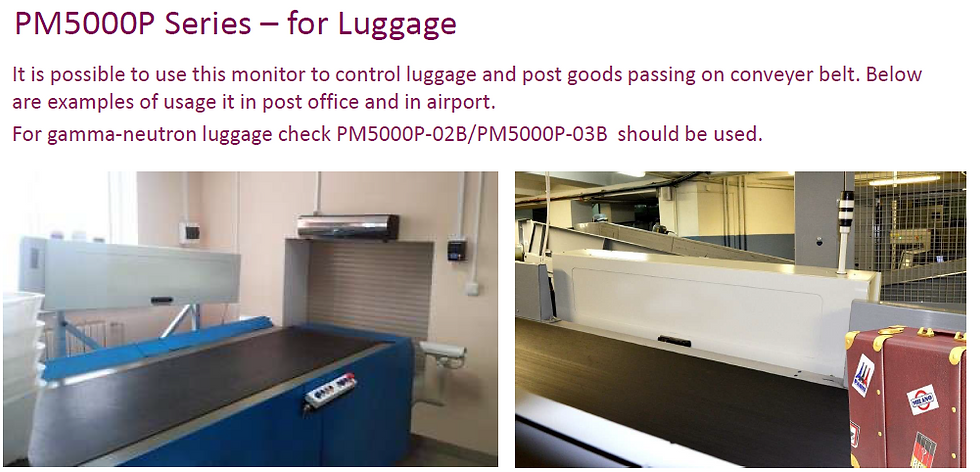
The PM5000P series can also control luggage and post goods passing on a conveyor belt, as in post offices and airport baggage handling. The monitor sits over or beside the belt and scans every item as it travels through.
Model selection tip: for gamma-neutron luggage checks, the PM5000P-02B or PM5000P-03B should be used.
Understanding the Specifications
All PM5000P models are specified for a maximum speed of 5 km/h. The tables below show the minimum detectable amount of each radioactive material, meaning the smallest quantity the monitor can reliably detect as it passes through. Lower numbers mean higher sensitivity.
Model Overview
Model | Detection type | Detection units | Max. speed |
PM5000P | Gamma | 1 | 5 km/h |
PM5000P-01 | Gamma | 2 | 5 km/h |
PM5000P-02B | Gamma + neutron | 1 | 5 km/h |
PM5000P-03B | Gamma + neutron | 2 | 5 km/h |
Control Zone Sizes
Each model is specified for two control zone sizes (width × height): 1.0 × 2.0 m and 1.5 × 2.0 m. A wider zone gives you more room to pass larger items or people through, but the minimum detectable amounts rise (sensitivity falls) because the radiation source can be further from the detectors.
Minimum Detectable Amounts: Gamma-Emitting Sources
Values are in MBq, with µCi in brackets.
Model | Zone (W×H, m) | ²⁴¹Am | ¹³⁷Cs | ⁶⁰Co | ¹³³Ba |
PM5000P | 1.0 × 2.0 | 0.4 (11) | 0.08 (2) | 0.04 (1.1) | 0.05 (1.25) |
PM5000P | 1.5 × 2.0 | 0.7 (19) | 0.13 (3.5) | 0.07 (1.9) | 0.08 (2.16) |
PM5000P-01 | 1.0 × 2.0 | 0.12 (3.2) | 0.022 (0.59) | 0.012 (0.32) | 0.013 (0.36) |
PM5000P-01 | 1.5 × 2.0 | 0.175 (4.75) | 0.033 (0.88) | 0.0175 (0.475) | 0.02 (0.54) |
PM5000P-02B | 1.0 × 2.0 | 0.75 (20) | 0.12 (3.2) | 0.065 (1.8) | 0.075 (2) |
PM5000P-02B | 1.5 × 2.0 | 1.29 (35) | 0.21 (5.6) | 0.11 (3) | 0.13 (3.5) |
PM5000P-03B | 1.0 × 2.0 | 0.2 (5.5) | 0.032 (0.87) | 0.018 (0.47) | 0.02 (0.55) |
PM5000P-03B | 1.5 × 2.0 | 0.33 (8.75) | 0.048 (1.3) | 0.026 (0.71) | 0.03 (0.8) |
Minimum Detectable Amounts: Nuclear Materials
Model | Zone (W×H, m) | ²³⁸U (g) | ²³⁵U (g) | ²³⁹Pu (g) | ²³⁹Pu behind 4 cm Pb (g) | ²⁵²Cf (neutrons/s) |
PM5000P | 1.0 × 2.0 | 470 | 30 | 0.8 | n/a | n/a |
PM5000P | 1.5 × 2.0 | 815 | 50 | 1.4 | n/a | n/a |
PM5000P-01 | 1.0 × 2.0 | 140 | 8.5 | 0.24 | n/a | n/a |
PM5000P-01 | 1.5 × 2.0 | 205 | 12.5 | 0.36 | n/a | n/a |
PM5000P-02B | 1.0 × 2.0 | 870 | 47 | 1.4 | 110 | 6,500 |
PM5000P-02B | 1.5 × 2.0 | 1,500 | 80 | 2.3 | 188 | 11,250 |
PM5000P-03B | 1.0 × 2.0 | 250 | 13.4 | 0.4 | 42 | 2,500 |
PM5000P-03B | 1.5 × 2.0 | 380 | 20 | 0.6 | 62 | 3,700 |
What the Numbers Tell You
Dual-unit models are the most sensitive. The PM5000P-01 and PM5000P-03B use two detection units, one on each side, and detect roughly three to four times smaller quantities than their single-unit counterparts at the same zone size.
Gamma-only models (PM5000P and PM5000P-01) cover the isotopes and nuclear materials in the gamma columns, but do not provide the neutron detection needed for ²⁵²Cf or for plutonium behind lead shielding.
Gamma-neutron models (PM5000P-02B and PM5000P-03B) add neutron detection. This is what allows them to detect ²⁵²Cf and ²³⁹Pu even when it is shielded by 4 cm of lead, which is a shielding scenario a gamma-only system cannot cover.
Narrower zones are more sensitive. Moving from a 1.5 m to a 1.0 m wide zone improves the minimum detectable amount for every material.
Choosing the Right Model
Your requirement | Recommended model |
Basic gamma screening, cost-sensitive | PM5000P |
High-sensitivity gamma screening | PM5000P-01 |
Gamma + neutron screening, standard sensitivity | PM5000P-02B |
Gamma + neutron screening, highest sensitivity | PM5000P-03B |
Vehicle and rail screening | PM5000B series |
Airport or post office conveyor belts (gamma-neutron) | PM5000P-02B or PM5000P-03B |
Verified Through Real Testing
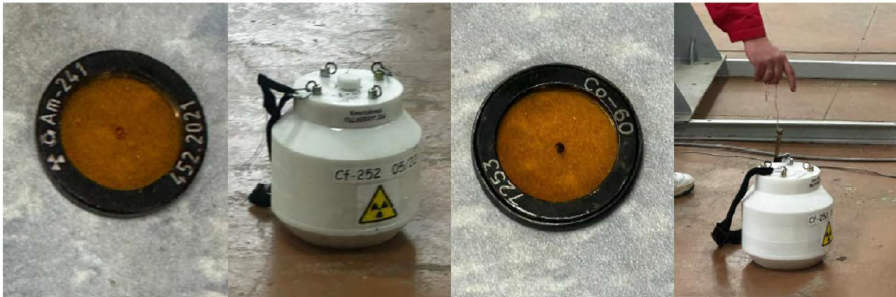
Performance is checked using physical calibrated sources. The catalogue shows test setups with Am-241 and Co-60 sealed sources and a Cf-252 neutron source moved through the monitored zone on a test rig, with operators recording the results. This kind of hands-on testing confirms that the monitor responds to real radioactive sources at the quoted detection levels.
Key Benefits at a Glance
Non-intrusive. Items and people are screened in motion with no stopping or opening.
Gamma and neutron capability. Covers a wide range of radioactive and nuclear materials, including shielded plutonium (neutron models).
Scalable sensitivity. Single or dual detection units, and 1.0 m or 1.5 m wide zones, match the monitor to the application.
Complete system. Detectors, software, workstation, alarms and CCTV work together, so every alarm has evidence attached.
Versatile. Suitable for vehicles, trains, pedestrians, luggage and bulk goods.
Proven across sectors. Used at borders, airports, nuclear sites, scrap yards, government buildings, banks and post offices.
Conclusion
Radiation Portal Monitors let organisations protect people, borders, facilities and supply chains without slowing down legitimate movement. With the PM5000 range, you can choose between gamma-only and gamma-neutron detection, single or dual detection units, and configurations for vehicles, pedestrians or luggage.
Interested in a Radiation Portal Monitor for your facility? Contact our team to discuss your site, throughput and detection requirements, and we will help you select the right model.






Comments