
Car and Vehicle X-Ray Scanners | Godrej Security Solutions

Car and Vehicle X-Ray Scanners: Features, Specifications and How They Work
Explore our Car/Vehicle X-ray scanner range, from the hand-portable CXR to the drive-through PORTAL-9232 2V1L. Learn how the systems detect explosives, narcotics, weapons and concealed persons.
Introduction
Vehicles are one of the most common ways to move contraband, weapons and explosives past a checkpoint. A car has door panels, seat cavities, roof spaces, fuel tanks, spare wheels and undercarriage voids, and a manual search of all of them is slow, invasive and easy to get wrong.
Vehicle X-ray inspection solves this by letting security teams look inside a vehicle in seconds, without opening a single door. Our Car/Vehicle X-ray Scanner line covers two situations:
CXR Car X-Ray Scanner: a hand-portable, quick-to-deploy system for cars at checkpoints, entrances and temporary sites.
PORTAL-9232 2V1L: a high-throughput, dual-view drive-through system for cargo and vehicles at ports, airports, border crossings and government facilities.
This guide covers every feature of both, with an explanation of why each one matters.
Why X-Ray Scan a Car?
Threats are rarely visible. They are hidden under seats, behind trim panels, inside roof cavities, in boot spaces and in modified chassis voids. Searching for them by hand has three problems:
It is slow. Queues build up and checkpoints become a bottleneck.
It is unreliable. A search is only as good as the searcher's attention, and concealment methods keep improving.
It exposes staff to risk. Opening a vehicle that contains an explosive puts the inspector in danger.
X-ray imaging addresses all three. It shows the inside of a vehicle quickly, consistently and from a safe distance, and it flags only the vehicles that need a physical search.
Part 1: CXR Car X-Ray Scanner


Overview
The CXR gives a comprehensive overhead X-ray of the vehicle interior, covering the passenger compartment, the boot space and the roof cavity. A vehicle drives through or past the scanner and the operator sees an image of everything inside.
Scan capabilities
Top-down X-ray imaging of the full vehicle profile. The overhead view covers the whole vehicle in one image, so the operator can compare the layout against what a normal car of that model looks like.
Reveals items hidden under seats and behind trims. Seat bases, door cards, headliners and trim panels are classic hiding places. X-ray passes through these panels and shows what is behind them.
Detects IEDs, drugs, weapons and persons. The CXR is built for the main checkpoint threats: improvised explosive devices, narcotics, firearms and other weapons, and people hidden in boots or cavities.
Overhead gantry or handheld deployment. The scanner can be set up as an overhead gantry that the vehicle passes beneath, or used handheld over the vehicle. This suits both fixed checkpoints and mobile operations.
Imaging views
The CXR comes in Top View and Side View variants. The top view shows the layout of the vehicle from above, including the engine bay, the passenger compartment, the fuel tank and the spare wheel area. The side view shows seating positions, the roofline and the vertical profile, which makes it easy to spot a person or object that is out of place.
CXR performance parameters
Parameter | Specification |
Scan time | 5–10 seconds per vehicle |
Radiation | Safe low-dose X-ray levels |
Power source | 2 × 12V motorcycle batteries |
AC power alternative | Single-phase AC adapter |
Weight / form | Hand-portable, trunk-sized |
Assembly | No tools, deployed in minutes |
Control interface | Standard Windows laptop |
Connectivity | Wi-Fi (remote) and wired |
Imaging views | Top View and Side View variants |
Detection | IEDs, drugs, weapons, contraband |
Deployment | Fixed checkpoint or mobile unit |
Covert option | Behind signs and planters |
Feature explanations
Scan time of 5–10 seconds. A vehicle is imaged in a few seconds, so inspection adds very little to the wait at the gate. The image is ready for review almost immediately.
Low-dose X-ray. The system is designed to operate at safe low-dose levels. The operator works from a laptop at a distance rather than standing beside the scan.
Battery-powered operation. Two 12V motorcycle batteries can run the system, so it works where there is no mains supply, such as roadside checkpoints, temporary event security and remote posts. A single-phase AC adapter is available where mains power exists.
Hand-portable, trunk-sized. The whole system is small enough to carry and to fit in the boot of a car, so one team can move it between sites as the threat picture changes.
No tools, minutes to deploy. Because assembly needs no tools, a trained team can bring it into service within minutes, which makes it practical for short-notice or temporary deployments.
Standard Windows laptop control. There is no proprietary console. Operators run the scanner from a standard Windows laptop, which keeps training and maintenance simple.
Wi-Fi and wired connectivity. The wired link is dependable, and the Wi-Fi option lets the operator sit at a safe, comfortable distance from the scan area. Images can also be passed to a supervisor or control room.
Fixed or mobile deployment. The same equipment works as a permanent checkpoint installation or a mobile unit that moves with the operation.
Covert option. The scanner can be concealed behind signs and planters. This suits sensitive sites that want discreet screening, such as hotels, embassies and corporate campuses, without a heavy-handed security look.
Part 2: PORTAL-9232 2V1L, the Drive-Through System for Cargo and Vehicles
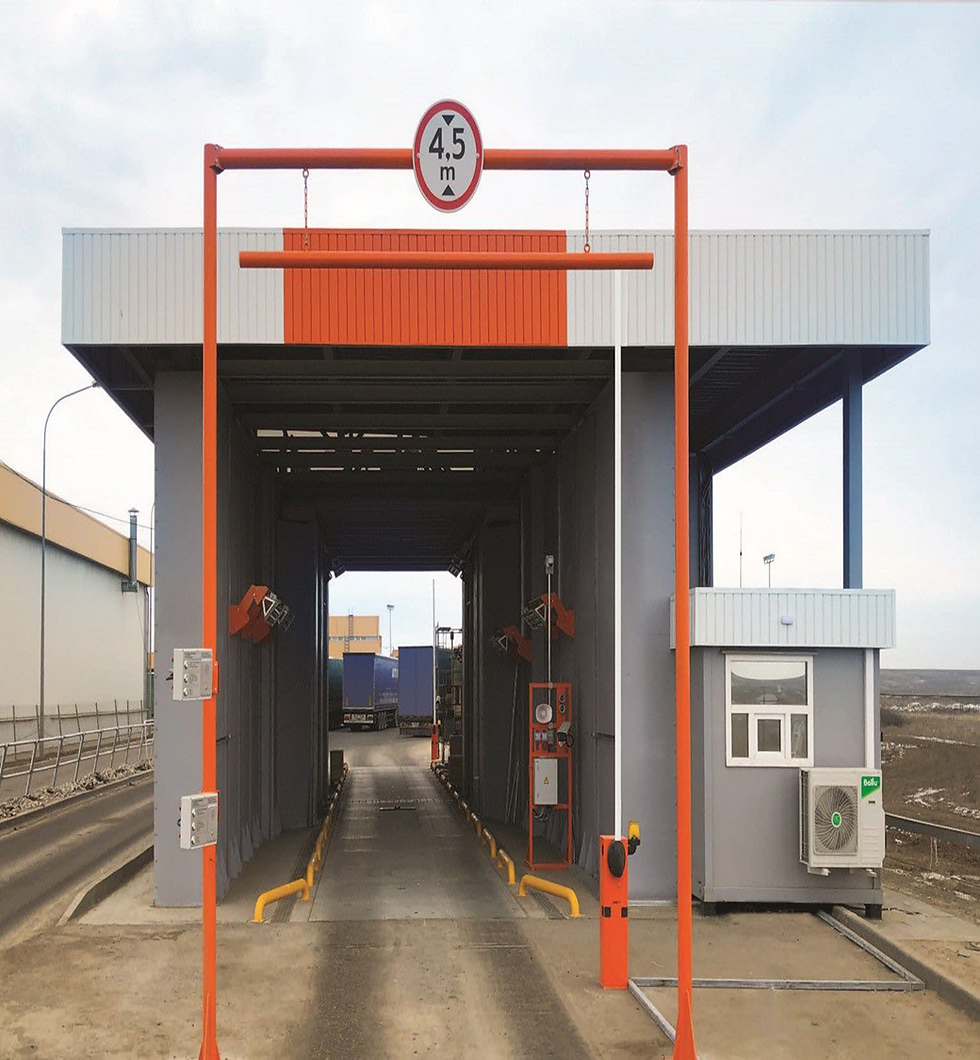
For high volumes and larger vehicles, the PORTAL-9232 2V1L is a high-throughput, dual-view X-ray inspection system for cargo and vehicles. It is designed for ports, airports, border crossings and government facilities, and it detects explosives, narcotics, WMDs and contraband without manual inspection. The configuration described here is the drive-through option, with optional towing.
Key features
1. Dual view (side and top)
Two L-shaped detectors and two X-ray sources capture a side view and a top view simultaneously. A single-view system can miss an object that is hidden behind other cargo from one angle. Two views from two angles make concealment much harder, and the operator gets a far more complete picture from one pass.
2. 120 vehicles per hour
Vehicles drive through at 3–10 km/h without stopping. Throughput of up to 120 vehicles per hour is the headline figure, and a single pass gives a full scan with no need to re-scan. For busy ports and borders this is the difference between a smooth flow and a queue.
3. 320 mm steel penetration
A 9 MeV betatron delivers penetration through up to 320 mm of steel. This lets the system image dense cargo and shielded threats, where lower-energy systems would show only a dark, unreadable area. Energy is switchable between 9 MeV and 6 MeV, so the operator can match it to the load.
4. Operating range of −40°C to +60°C
The system operates in extreme weather, from freezing border posts to hot port terminals. It has low energy consumption, and operator workplaces can be placed remotely, anywhere on the network.
5. Material discrimination
The system uses dual-energy imaging to separate organic and inorganic materials in a single scan pass and colour-codes them on screen. Suspicious regions are highlighted for the operator to review. The colour guide is explained in detail below.
6. Remote workstations
Imaging operators can be stationed anywhere and connect to a centralised image analysis centre. The system supports ANSI and IEC compliance. Remote analysis lets an organisation put its best analysts in one place, support several lanes or sites, and keep staff away from the scan area.
Detailed technical specifications
General performance
Parameter | Specification |
Inspected object (L×W×H) | 30 × 3 × 4.7 m |
Building (L×W×H) | 24.6 × 11.6 × 7.8 m |
Max object weight | 55,000 kg |
Throughput | Up to 120 vehicles/hr |
Scan speed | 3–10 km/h |
Number of X-ray generators | 2 |
Type of accelerator | Betatron |
X-ray energy | 9 / 6 MeV (switchable) |
Steel penetration | 320 mm |
Radiation and safety
Parameter | Specification |
Max dose per scan | < 5 µSv |
Max driver dose per scan | < 0.3 µSv |
Environmental dose (boundary average) | < 0.5 µSv/hr |
Annual environmental boundary dose | < 1 mSv/year |
Operator room dose rate | Background level |
Radiation portal monitor | Automatic, included |
ANSI N43.17-2009 | Portal mode ✓ |
ANSI N42.46-2008 | Compliant ✓ |
IEC 62523:2010 | Compliant ✓ |
Imaging and systems
Parameter | Specification |
Views | Dual (side + top) |
Detector type | L-shaped (×2) |
Material discrimination | Organic / inorganic |
Image magnification | Up to 16× |
Image processing | Storage, contrast, filter, segment |
Display | Multiple high-resolution TFT PCs |
Workstation placement | Remote / anywhere |
Power | 380V / 50Hz 3-phase |
Power consumption | ≤ 30 kW |

What the specifications mean in practice
Inspected object size of 30 × 3 × 4.7 m and 55,000 kg. The system takes full-size trucks with trailers and containers, as well as cars and vans. The 4.7 m clearance and 3 m lane aperture are the key figures for planning vehicle access.
Dose figures. The maximum dose is under 5 µSv per scan, and the maximum dose to the driver is under 0.3 µSv per scan. The environmental dose at the site boundary averages under 0.5 µSv/hr, with an annual boundary dose under 1 mSv/year. The operator room reads at background level, and an automatic radiation portal monitor is included. Compliance with ANSI N43.17-2009 (portal mode), ANSI N42.46-2008 and IEC 62523:2010 gives buyers and regulators a recognised standard to check against.
Image magnification of up to 16×. The operator can zoom in on a suspicious zone to see individual components. Along with contrast, filtering and segmentation tools, this supports confident decisions.
Image storage. Every scan is stored, which supports audit trails, repeat review and training.
Power. The system runs on 380V / 50Hz three-phase power and draws no more than 30 kW.


Understanding the Colour-Coded Material Discrimination
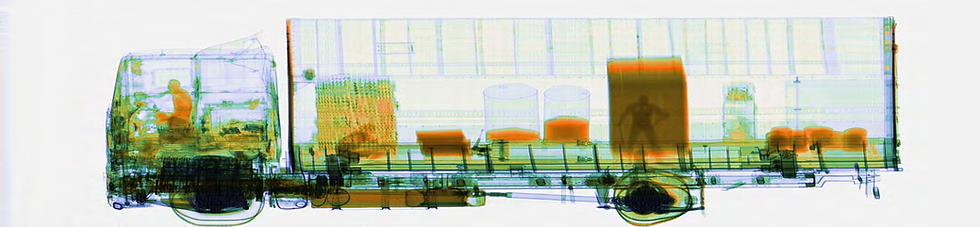
Dual-energy imaging reads how different materials absorb X-rays at two energy levels. The scanner uses this to estimate a material's effective atomic number (Z) and colours the image accordingly in real time.
Category | Z range | Screen colour | Typical items |
Organic | Z ≈ 1–10 | Orange/brown | Narcotics, explosives, human stowaways, chemical precursors, biological contraband |
Mixed | Z ≈ 10–18 | Green | Concealed items in mixed cargo, aluminium structures, ammonium nitrate, drug-filled electronics, fertiliser precursors |
Inorganic | Z ≈ 18–50 | Blue | Firearms, ammunition, grenades, bladed weapons, undeclared gold or currency, military equipment, modified vehicle cavities |
High-Z | Z > 50 | Black | Lead shielding, radioactive sources, dense weapon components, lead-lined containers |
Organic (orange). Organic materials are made of light elements such as carbon, hydrogen, nitrogen and oxygen. Most narcotics and many explosives fall into this group, which is why the orange zones draw the closest attention.
Mixed (green). This is a middle category. It includes composite materials and some precursors, and it often means "look closer".
Inorganic (blue). Heavier metals appear here. Firearms, ammunition, blades and military hardware all show up in this category, as do modified cavities built into a vehicle.
High-Z (black). Very dense materials absorb almost everything and appear black. Lead shielding, which smugglers use to hide a radioactive source, is itself a warning sign, and a radioactive source also triggers the radiation portal monitor.
The colours are an aid to the operator, not a verdict. Suspicious regions are highlighted so a trained analyst can review them.
Scan Outputs: What the Operator Actually Sees
Each pass produces two simultaneous images, a side view (horizontal) and a top view (vertical), from two independent L-shaped detector arrays.
Example 1: Hidden round objects. In a truck carrying a large load of round items such as tyres, drums or spheres, the side view shows a dense block and the top view shows the individual round objects packed together. The red-boxed zones and zoom-in show how a hidden object among regular cargo stands out when seen from two angles.
Example 2: Chassis and axle cavity inspection. The top view shows the undercarriage and axle space, a common concealment location. The zoomed image shows individual components, such as wheels, bars and other items, in enough detail to spot anything that does not belong.
Example 3: Dual-energy colour image. A truck scanned with material discrimination shows organic cargo in orange, metal structure in green and blue tones, and even the outline of a person in the cargo area.
The Vehicle Inspection Flow: Nine Steps, Under 30 Seconds
The PORTAL-9232 2V1L follows a defined process in three phases.
Phase 1: Pre-entry
Vehicle halts at the entry zone. The driver stops at the designated entry point and waits for the traffic marshal's instruction, with the engine running. The vehicle does not enter until clearance is given.
Passengers alight. All passengers leave the vehicle and go to the waiting area on foot. Only the driver stays in the vehicle, and no passengers may be inside during the scan.
Permission to enter. The imaging operator checks that the detectors are ready and that nobody is in the scan zone. The operator then gives the traffic marshal permission to proceed by radio or speakerphone.
Phase 2: Scan
Vehicle enters and positions. The driver enters the portal zone at low speed and positions the vehicle using the road markings. The traffic marshal guides alignment so that the scan covers the whole vehicle.
Drive-through scan. The vehicle passes through the stationary portal at 3–10 km/h with no stopping. Both X-ray sources fire at the same time and capture side and top views in one continuous pass.
Scan complete, images saved. X-ray emission stops automatically once the vehicle clears the portal. Both images are saved to the server at once with the vehicle ID, time stamp, operator ID and a link to the cargo manifest.
Phase 3: Decision
Image analysis. The imaging operator reviews both views on a multi-monitor workstation. Suspicious zones are enlarged (up to 16×), colour-coded and marked, and material discrimination is applied. A shift supervisor then reviews the result.
Decision made. If there is no suspicion, the supervisor clears the vehicle, the documents go back to the driver and the vehicle leaves normally. If there is suspicion, the vehicle is diverted to a manual inspection bay for a secondary search.
Next vehicle cleared. The traffic marshal lets the next vehicle in. The total cycle is under 30 seconds in drive-through mode, and the system is ready for the next scan immediately, with no cooldown or reset.
The headline numbers: under 30 seconds per vehicle, 3–10 km/h drive-through speed, 120 vehicles per hour at peak, 9 steps in total, and zero stops required for the driver.
The key point of this flow is that the heavy workload falls on the imaging system, not on a manual search team. Only the vehicles that raise a flag go to secondary inspection.
System Design and Site Requirements
The PORTAL-9232 2V1L is a purpose-built installation. Planning the site means understanding its main components.
Component | Description |
Vehicle entry | The lane is open, with no physical barrier. The 24.6 m clear length accommodates the longest vehicles. |
Portal frame and detector housing | A prominent orange U-frame with an orange-clad upper section. Behind it, shielded detector wall panels run along both sides of the lane. |
Shielded detector walls | The dark green cladding provides radiation shielding. The L-shaped detectors are mounted inside and run the full building depth of 24.6 m. |
Operator cabin and staircase | A separate cabin, away from the scan zone, houses the imaging PCs, servers, control console and HVAC. |
Building slab / platform | A reinforced concrete slab, which is the customer's civil scope. It must carry vehicle loads of up to 55,000 kg and sit flush with the road surface through the lane. |
Key dimensions
Dimension | Value |
Building length | 24.6 m |
Building width | 11.6 m |
Building height | 7.8 m |
Lane aperture | 3 m |
Height clearance | 4.7 m |
Inspected object | 30 m long, 3 m wide, 4.7 m high, up to 55,000 kg |
Because the building and slab are part of the customer's planning, early engagement with the site team on dimensions, civil works, three-phase power and network connectivity keeps the project on schedule.
Benefits at a Glance
Speed: up to 120 vehicles per hour on the portal and 5–10 seconds per car on the CXR.
Detection depth: dual-view imaging, up to 320 mm steel penetration and colour-coded material discrimination.
Safety: low per-scan doses, driver dose under 0.3 µSv, and a radiation portal monitor included.
Standards: compliance with ANSI N43.17-2009, ANSI N42.46-2008 and IEC 62523:2010.
Flexibility: from a trunk-sized portable unit to a full drive-through installation.
Resilience: −40°C to +60°C operation, with battery power on the CXR.
Data and control: every scan is saved with vehicle ID, time stamp and operator ID, and remote workstations connect to a central analysis centre.
Fewer manual searches: only flagged vehicles go to secondary inspection, which reduces risk to staff and delays for drivers.
Who Uses Vehicle X-Ray Scanners?
Ports and customs: screening cargo trucks and containers for smuggling.
Airports: perimeter and cargo access control.
Border crossings: high-volume screening of cars, vans and trucks.
Government and diplomatic facilities: controlling vehicle access to sensitive sites.
Law enforcement and military checkpoints: fixed or mobile vehicle screening.
Event and venue security: temporary or covert screening, using the portable CXR.
Frequently Asked Questions
How long does a scan take?The CXR scans a car in 5–10 seconds. The PORTAL-9232 2V1L completes a full vehicle cycle in under 30 seconds.
Is the radiation safe?The CXR operates at safe low-dose levels. The PORTAL-9232 2V1L keeps the dose below 5 µSv per scan and below 0.3 µSv for the driver, and it meets ANSI and IEC standards. Passengers must leave the vehicle before a portal scan.
Does the vehicle have to stop?Not on the portal. Vehicles drive through at 3–10 km/h without stopping.
Can it run without mains power?Yes. The CXR runs on two 12V motorcycle batteries, with an AC adapter as an alternative.
Can it be installed discreetly?Yes. The CXR has a covert option for placement behind signs and planters.
What can it detect?IEDs and other explosives, narcotics, weapons and ammunition, concealed persons and other contraband. The portal also helps identify shielding materials and, with its radiation portal monitor, radioactive sources.
Can operators work remotely?Yes. Workstations can be placed anywhere on the network and connected to a centralised image analysis centre.
Get in Touch
Whether you need a portable scanner for a mobile checkpoint or a full drive-through portal for a port or border, we can help you choose the right configuration. Contact us for a demo, a site assessment or a detailed quotation.






Comments